The Traitors
About The Traitors
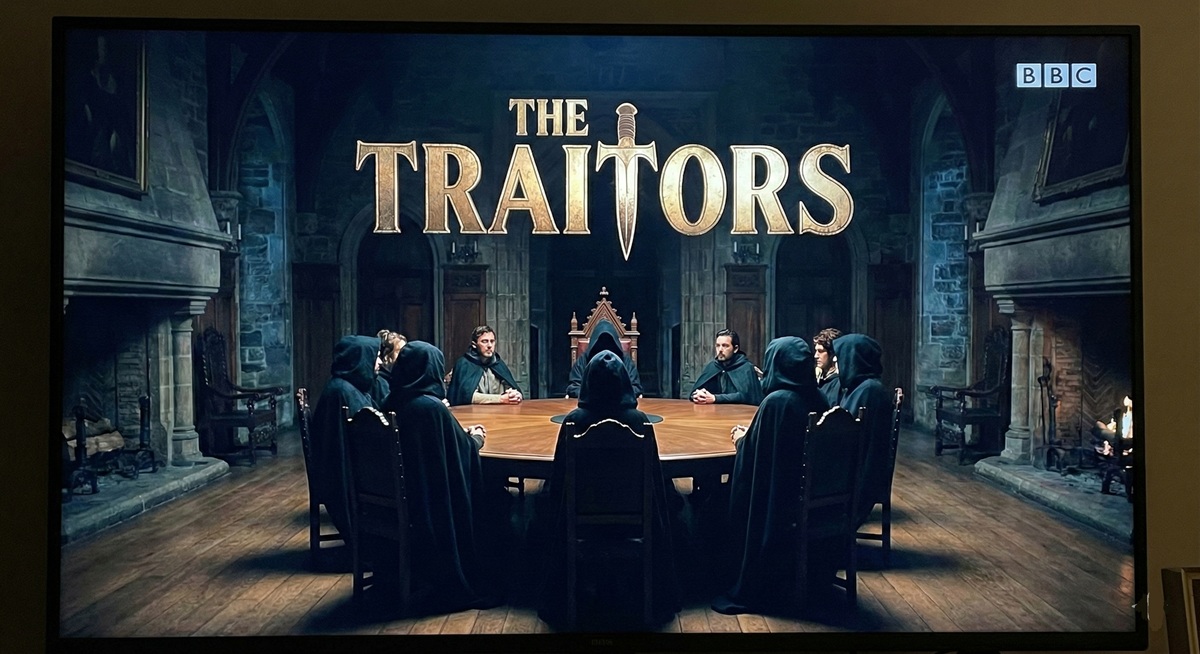
The Traitors is a BAFTA-winning psychological reality game show that has become one of the BBC’s biggest hits — and, by early 2026, the most-watched programme on British television. Based on the Dutch format De Verraders, the show was commissioned by the BBC in October 2021 and first filmed in May 2022. Hosted by Claudia Winkleman, it brings together a group of strangers in a Scottish castle where they must complete missions to build a prize fund of up to £120,000.
The original concept was dreamt up by Dutch television producer Marc Pos back in 2014, alongside Jasper Hoogendoorn, after Pos read Muiterij op de Batavia (Mutiny on the Batavia), a book about a bloody uprising aboard a shipwrecked Dutch East India Company vessel. Pos initially pitched the idea as De Muiters (The Mutineers), set on a ship with gameplay similar to the social deduction party game Mafia. The nautical setting proved too expensive to produce, but after years of refinement and persistence, Pos sold the format to Dutch network RTL, where it debuted as De Verraders on 13 March 2021 with Tijl Beckand as host.
Within months, international broadcasters came calling. The Traitors franchise has since spawned over 17 official international versions, but the British edition — produced by Studio Lambert Scotland for BBC One — has become the jewel in the crown. The show won two BAFTAs in 2023: Reality & Constructed Factual, and Entertainment Performance for Claudia Winkleman. In March 2026, the BBC signed a three-year deal ensuring The Traitors and its celebrity spin-off will remain in production until at least 2030. Not bad for a format that started life as a story about mutiny on a 17th-century merchant ship.
Filming Location
The Traitors is filmed at Ardross Castle, a stunning 19th-century estate in Ross-shire in the Scottish Highlands, approximately 30 miles north of Inverness. The castle’s gothic architecture and misty Highland surroundings provide the perfect atmospheric backdrop for the game’s deception and drama. The turrets, candlelit corridors and sweeping grounds have become as iconic as the show itself, and Ardross has firmly established itself as the spiritual home of The Traitors franchise.
How It Works
At the start of the game, a small number of contestants are secretly selected as “Traitors” while the rest are “Faithfuls”. Each night, the Traitors meet in secret to “murder” a Faithful, eliminating them from the game. During the day, all players discuss and vote to “banish” whoever they suspect of being a Traitor.
The Faithfuls win if they banish all the Traitors. The Traitors win if they remain undetected until the end. The surviving players share the prize pot — but if any Traitors remain, only they take the money. It is a brilliantly simple premise that generates extraordinary tension: every conversation could be a lie, every alliance a trap, and every roundtable vote a potential death sentence.
Where to Watch
- Live: BBC One
- Catch-up: BBC iPlayer
- Time: 8pm on Wednesday to Friday during its run (typically January)
Series History
| Series | Year | Contestants | Winners | Role | Prize | Finale Viewers (7-day) |
|---|---|---|---|---|---|---|
| Series 1 | 2022 | 22 | Aaron Evans, Hannah Byczkowski, Meryl Williams | Faithfuls | £101,050 (split 3 ways) | 4.7M |
| Series 2 | 2024 | 22 | Harry Clark | Traitor | £95,150 | 8.0M |
| Series 3 | 2025 | 25 | Jake Brown, Leanne Quigley | Faithfuls | £94,600 (split) | ~8.2M |
| Series 4 | 2026 | 22 | Rachel Duffy, Stephen Libby | Traitors | £95,750 (split) | 9.4M |
| Celebrity Series 1 | 2025 | 19 | Alan Carr | Traitor | £87,500 (charity) | 11.1M |
The trajectory tells its own story. From a promising but modestly watched debut in late 2022, The Traitors has grown into a genuine television phenomenon, with consolidated seven-day figures climbing with every civilian series.
Series 3 Recap (2025)
Series 3 launched on New Year’s Day 2025 with 25 contestants — the most in any version of The Traitors worldwide — and immediately raised the stakes. The opening episode featured a dramatic twist aboard the coach to Ardross Castle, where Claudia forced three players — Fozia, Jack and Alexander — to step off, adding £10,000 to the prize fund in the process. It set the tone for a series packed with surprises.
The original Traitors selected by Claudia were Linda Rands, Minah Shannon and a third player, but none of them would make it to the finale — a first for the UK version.
Minah was the breakout star of the series, a 29-year-old who carried the Traitor role with extraordinary confidence. By day she charmed her fellow contestants with warmth and sincerity; by night she plotted their murders without a flicker of remorse. She recruited Charlotte as a fellow Traitor partway through the series, issuing her an ultimatum she could not refuse. Minah was eventually banished in Episode 10 after suspicions finally caught up with her, but not before delivering some of the most compelling Traitor gameplay the show has ever seen.
Linda was banished earlier in the run after seven players — including her fellow Traitor Minah — wrote her name at the roundtable. It was a cold-blooded move that underlined just how ruthless the game can be, even among supposed allies.
One of the standout moments was the “Death Match” challenge in Episode 6, where the Traitors wrote four names on a painting and those players competed in three rounds of cards. The last remaining Faithful was murdered face-to-face by the Traitors — a visceral twist that had viewers gripping their sofas.
The finale came down to Jake Brown, Leanne Quigley, Francesca and Alexander. In a tense sequence of votes, Alexander was banished first, followed by Francesca. That left Jake and Leanne — both Faithfuls — to split the £94,600 prize pot. A deserved victory for two players who had navigated weeks of paranoia and deception with their instincts intact.
Series 4 (2026)
Series 4 premiered on 1 January 2026 and concluded on 23 January with a finale watched by 9.4 million viewers — a record for the civilian version. The first three episodes all exceeded 11 million viewers on consolidated seven-day figures, with the launch pulling in a staggering 11.9 million.
This series introduced the “Secret Traitor” twist, the biggest format shake-up since the show began. Claudia selected barrister Hugo (51), head of communications Rachel Duffy (42) and cybersecurity consultant Stephen Libby (32) as the three known Traitors. But a fourth — Fiona Hughes — was secretly designated as a hidden Traitor, unknown to both the other Traitors and the viewers until Episode 4, when Stephen and Rachel completed a challenge to uncover her identity.
Among the 22 contestants were a retired police detective (Amanda), a crime writer, a psychologist (Ellie), and — in a first for the show — a mother-and-daughter duo (Judy and Roxy Wilson) and a dating couple (Ellie Buckley and Ross Garshong).
Hugo, the barrister, became an early target. Fiona, the newly revealed Secret Traitor, helped put a target on his back by questioning his behaviour after the train ride. Despite his best legal arguments, Hugo was banished with 10 votes — proof that courtroom skills do not always translate to the roundtable.
The most explosive drama of the series was the rivalry between Fiona and Rachel. After Amanda was banished following a tie-break roundtable, Rachel revealed to the group that Amanda had told her she was a retired police detective. Fiona — herself a Traitor — publicly accused Rachel of lying and declared she believed Rachel was a Traitor. The confrontation sent shockwaves through the castle and split the group, with both women campaigning openly to banish the other. It was, as one viewer put it, “nuclear war” — and it made for utterly riveting television.
In the finale, Rachel Duffy and Stephen Libby became the first pair of Traitors to win the UK version, sharing a prize pot of £95,750. Rachel credited her years of playing the social deduction game Mafia for teaching her to lie convincingly while controlling her emotions. She said she planned to use the money to support her mother, who lives with Parkinson’s disease and dementia. Stephen said he would use his share to give something back to his parents, who had sacrificed a great deal to put him through university, and to help his father — a butcher by trade — pursue his passion for art.
Their win made history: the first time two Traitors survived to the end together in the UK version, and only the second time Traitors have taken the prize (after Harry Clark’s solo victory in Series 2).
Celebrity Traitors
The Celebrity Traitors launched on 8 October 2025 and ran for nine episodes, with Claudia Winkleman once again at the helm at Ardross Castle. The cast of 19 celebrities playing for charity included some genuinely huge names: Stephen Fry, Tom Daley, Jonathan Ross, Alan Carr, Clare Balding, Kate Garraway, Charlotte Church, Paloma Faith, Celia Imrie, Joe Marler, Nick Mohammed, David Olusoga, Lucy Beaumont, Mark Bonnar, Joe Wilkinson, Cat Burns, Niko Omilana, Ruth Codd and Tameka Empson.
The format worked beautifully with famous faces. The celebrities brought larger-than-life personalities and a willingness to throw themselves into the paranoia and backstabbing that defines the game. The fact they were playing for charity rather than personal gain added an extra layer of emotional stakes.
Alan Carr emerged as the winner — and a Traitor, no less. In the finale, David Olusoga and Nick Mohammed chose to end the game alongside Carr, believing him to be a Faithful. When Carr revealed his true identity, he burst into tears. His win secured £87,500 for Neuroblastoma UK, a charity close to his heart. It was a genuinely moving moment and cemented the Celebrity edition as far more than a novelty spin-off.
The finale drew an astonishing average audience of 11.1 million viewers, peaking at 12 million — making it the BBC’s biggest ratings hit of 2025 and the most-watched episode of any version of The Traitors in the UK. A second celebrity series, expanded to ten episodes, has been commissioned for broadcast later in 2026.
Viewing Statistics
The Traitors’ growth in audience figures tells the story of a show that has gone from promising newcomer to the biggest thing on British television.
Series 1 (2022): Launched modestly with average overnight ratings of around 3.2 million. The finale pulled in 4.7 million on consolidated seven-day figures. A strong start, but the show was still finding its audience.
Series 2 (2024): Word of mouth did its work. The series opened to 5.9 million and the finale surged to 8.0 million consolidated viewers — a near-doubling of the Series 1 peak.
Series 3 (2025): The launch episode was watched by 9.2 million on consolidated figures. The series maintained strong numbers throughout, with the finale reaching approximately 8.2 million.
Series 4 (2026): Record-breaking across the board. The launch episode hit 11.9 million on seven-day consolidated figures. The first three episodes all exceeded 11 million. The finale drew 9.4 million live viewers, peaking at 9.6 million with a 54.9% audience share — meaning more than half of everyone watching television at that moment was watching The Traitors. It was two million ahead of the previous year’s finale.
Celebrity Series 1 (2025): The celebrity edition outperformed even the civilian series, with a finale averaging 11.1 million and peaking at 12 million viewers.
To put those numbers in context: in an era of streaming fragmentation, where pulling 5 million viewers is considered a hit, The Traitors is consistently drawing audiences that would have been impressive in the golden age of terrestrial television. It is, by any measure, a phenomenon.
How The Traitors Compares to Other Reality Shows
British reality television has had no shortage of cultural moments over the years — from the early Big Brother era to the Love Island summers that dominated social media. But The Traitors has carved out something genuinely different, and it is worth considering why.
For a start, it does not rely on romance or physical attractiveness to generate drama. There are no bikini-clad contestants lounging by a pool. Instead, The Traitors is built entirely on psychology, strategy and the deeply human impulse to trust — or betray — the people around you. It is, at its core, an intellectual game wrapped in reality television packaging, and that gives it a breadth of appeal that shows like Love Island or I’m a Celebrity struggle to match.
The show also benefits from a remarkably diverse audience. While Love Island skews heavily towards younger viewers, The Traitors pulls in families, older viewers and people who would never normally watch reality TV. Part of that is down to its BBC One primetime slot and the lack of any content that might make you uncomfortable watching with your parents. But it is also because the game itself — who is lying, who can you trust, who will be caught out — is universally compelling. It taps into something primal.
Then there is the format itself. Unlike the weeks-long commitment required by Love Island or Big Brother, The Traitors runs for roughly three weeks in January, airing three times a week. That concentrated burst creates genuine event television — the sort of watercooler show that gets the nation talking in a way that longer-running series, which inevitably have fallow periods, cannot sustain.
Compared to I’m a Celebrity… Get Me Out of Here!, The Traitors offers a different kind of spectacle. I’m a Celeb thrives on the physical discomfort and celebrity fish-out-of-water comedy of the jungle. The Traitors thrives on suspicion, betrayal and the slow unravelling of alliances. Both are excellent television, but The Traitors arguably demands more from its audience — and rewards closer attention.
It is also worth noting how The Traitors has succeeded where so many game shows have failed: in creating genuine emotional stakes without enormous prize money. The pot rarely exceeds £120,000, which is modest by game show standards. Yet the roundtable banishments regularly produce tears, fury and raw emotional confrontations that rival anything on television. The stakes feel enormous because the betrayal is personal.
If The Traitors has a weakness, it is the risk of twist fatigue. Series 3 and 4 both introduced new mechanics — the Death Match, the Secret Traitor — and there is a danger that each series feels obliged to outdo the last. The original format is strong enough to sustain itself without constant reinvention, and the producers would do well to trust that.
But that is a minor quibble about a show that has, in the space of four years, become the defining British reality programme of the 2020s. With a three-year BBC deal secured through 2030 and viewing figures still climbing, The Traitors shows no sign of slowing down.
Host
Claudia Winkleman hosts The Traitors, bringing her signature wit and dramatic flair to the proceedings. Her BAFTA-winning hosting style — complete with all-black outfits and trademark fringe — has become synonymous with the show. Claudia’s ability to deliver devastating revelations with a mixture of glee and genuine empathy is a huge part of what makes The Traitors work. She is the puppet master who never lets you forget this is, above all, a game — and games are meant to be fun, even when they break your heart.
