What’s the best TV aerial for Freeview in the UK in 2026?
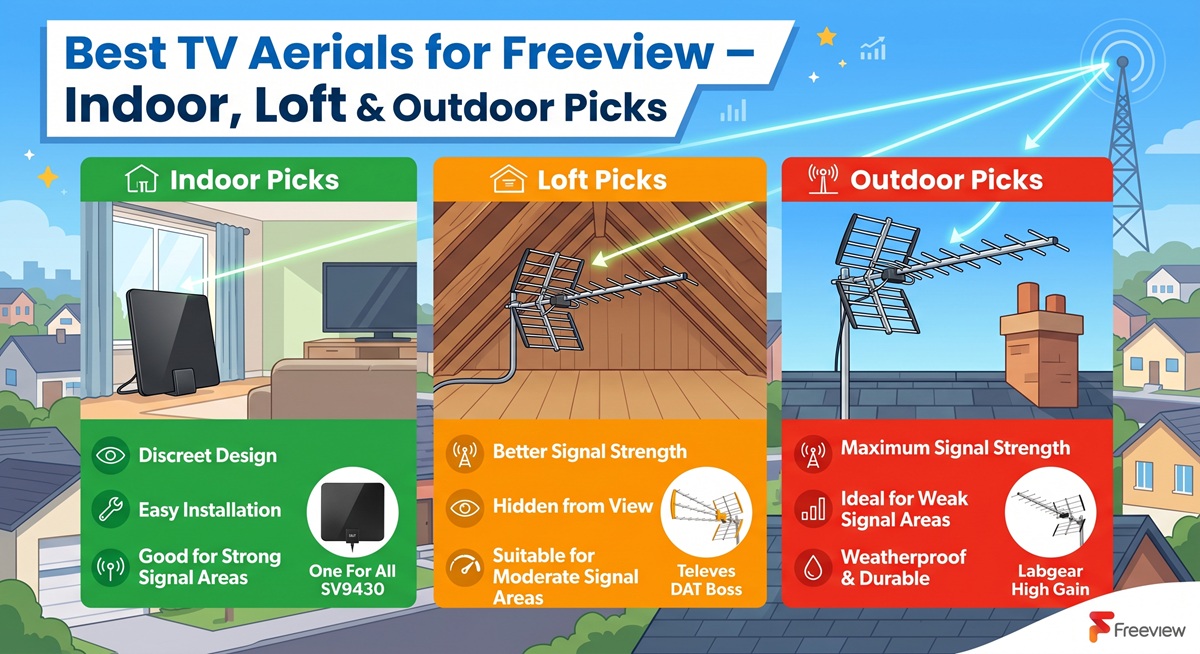
The best aerial depends on your distance from a main UHF transmitter. In strong-signal areas (within 25 miles), the SLx Digidome 360° amplified indoor aerial handles every Freeview channel with no roof work. In medium-signal areas (25–40 miles), a loft-mounted Labgear LHG10T 10-element high-gain aerial is the best value. For weak-signal or rural locations beyond 40 miles, a roof-mounted SLx 26-element Yagi with a 4G/5G filter is the only reliable option.
Below are tested 2026 picks for every signal strength, plus a step-by-step way to find out which type you actually need.
Editor’s choice (most homes):
The SLx Digidome 360° Amplified Indoor Aerial is the best all-rounder for typical UK households. Omnidirectional reception, integrated 4G/5G filter, plug-and-play setup, and around £30 on Amazon UK. Check current price ➜Why one pick, not three? Indoor aerials are highly area-dependent. If the Digidome works for you, you’re done. If it doesn’t, you need a loft or outdoor aerial — and indoor amplifier upgrades won’t save you. See the How to choose section below.
At-a-glance: which aerial for which home
| Your situation | Aerial type | Recommended model | Typical price |
|---|---|---|---|
| Flat, city centre, <20 miles from transmitter | Indoor, non-amplified | One For All Ultra Flat (SV9494) | £20–£25 |
| Suburb, 15–30 miles, walls in the way | Indoor, amplified omnidirectional | SLx Digidome 360° | £25–£35 |
| House with loft, 20–40 miles | Loft / outdoor Yagi | Labgear LHG10T 10-element | £30–£45 |
| Rural / weak signal, 40+ miles | Outdoor high-gain | SLx 26-element + 4G filter | £40–£65 |
| Caravan, motorhome, portable | Magnetic-base portable | August DTA240B | £15–£25 |
All prices are 2026 RRP on Amazon UK. Click through to check current pricing — aerial prices fluctuate weekly.
Best indoor aerials
1. SLx Digidome 360° Amplified — best all-rounder
Omnidirectional means you don’t have to point it at a specific transmitter, which solves the single biggest problem with cheap indoor aerials. The integrated USB-powered amplifier and 4G/5G filter handle weak urban signals where mobile interference is common. Roughly 18-mile reception range in real conditions.
- Range: ~18 miles (real-world)
- Type: Amplified, omnidirectional
- 4G/5G filter: Yes, built-in
- Power: USB (TV port) or mains
- Best for: Most UK homes within 25 miles of a transmitter
2. One For All SV9494 Ultra Flat — best budget indoor
A flat panel-style indoor aerial that mounts on the wall or sits behind your TV. Non-amplified but surprisingly capable in strong-signal areas. The 15-mile rated range is honest; don’t expect more. No 4G filter on the base model.
- Range: ~15 miles
- Type: Non-amplified, flat panel
- 4G/5G filter: No (upgrade to SV9495 for filtered version)
- Best for: Flats and city-centre homes near a main transmitter
3. August DTA240B — best portable
The aerial of choice for caravans, motorhomes and any setup where you move between locations. Magnetic base, foldable design, USB-powered amplifier. Surprisingly good in low-signal sites because of the directional design — you just have to point it at the nearest transmitter.
- Range: ~25 miles
- Type: Amplified, directional
- 4G/5G filter: Yes
- Best for: Caravans, motorhomes, secondary TVs
Best loft aerials
Labgear LHG10T 10-Element High-Gain — best loft pick
Loft installs are the British compromise: better than indoor, less hassle than a roof mount. The Labgear LHG10T is a proper Yagi-style aerial with 10 active elements and a high-gain design that compensates for the signal loss through roof tiles. Wired install required — you’ll need to run a coax cable from loft to TV.
- Range: ~40 miles (in loft)
- Type: Yagi, high-gain, passive
- 4G/5G filter: Yes, integrated
- Mounting: Pole / loft truss
- Best for: Homes with loft access, 20–40 miles from main transmitter
Tip: A loft aerial loses 30–50% of its signal compared to roof mounting. Always pick a “high-gain” model rated 5–10dB above your minimum required signal strength. The cheap 4-element loft kits sold on Amazon for £15 are not enough for anywhere outside London or Manchester.
Best outdoor aerials
SLx 26-Element Outdoor with 4G/5G Filter — best for weak-signal areas
If you live in a fringe-reception area — rural, behind a hill, more than 40 miles from your nearest main transmitter — there is no indoor or loft aerial that will work reliably. The SLx 26-element Yagi is the right answer. IP55 weatherproof rating, anti-rust aluminium construction, and a tight-pattern directional design that you aim at one transmitter.
- Range: ~60–70 miles
- Type: Yagi, 26-element, passive
- 4G/5G filter: Yes, integrated
- Build: IP55 weatherproof, aluminium
- Best for: Rural / weak-signal homes with a clear sightline to a transmitter
Important: Outdoor aerial installation usually means working at height. If you’re not comfortable on a ladder, pay a professional installer (around £80–£150 for a standard fit) rather than risk a fall. RDI-approved installers carry insurance and will diagnose your signal first.
How to choose the right Freeview aerial
Before you buy anything, work through these three checks. They take five minutes and will save you returning the wrong product.
Step 1: Check your transmitter and predicted signal
Go to freeview.co.uk/coverage and enter your postcode. You’ll see:
- Your nearest main transmitter (e.g. Crystal Palace, Sutton Coldfield, Winter Hill)
- Predicted signal strength — usually shown as “Good”, “Variable” or “Poor”
- Number of channels available — main transmitters carry 85+; smaller relays carry around 18
If predicted strength is Good, an indoor or loft aerial is fine. Variable means loft or outdoor only. Poor means outdoor with a high-gain model.
Step 2: Look at your distance to the transmitter
The Freeview coverage tool shows the distance. As a rule of thumb:
- Under 20 miles: indoor aerial works in most homes
- 20–40 miles: loft aerial preferred, outdoor if budget allows
- Over 40 miles: outdoor high-gain only — anything else is wasted money
Step 3: Check for obstacles
Hills, trees, multi-storey buildings and even thick brick walls all reduce signal. If you can’t see the sky in the direction of your transmitter from where the aerial will sit, increase your aerial spec by one tier (indoor → loft, loft → outdoor).
What about HDR, 4K and “future-proofing”?
Aerial manufacturers sometimes advertise “4K Ready” or “HDR Compatible” aerials. Marketing only — Freeview’s broadcast is HD at maximum, and aerials don’t care about resolution. Don’t pay a premium for these labels.
The one technical upgrade worth paying for is a 4G/5G LTE filter. UK mobile networks broadcast on frequencies adjacent to Freeview UHF, and without a filter you can get picture breakup when phones nearby are active. Every aerial we recommend above has one built in.
What about the new Freely service?
Freely is a 2024 successor to Freeview Play that delivers free-to-air channels over your broadband connection — no aerial required. If your home has fast broadband but poor aerial reception, Freely is a legitimate alternative to buying a new aerial. Currently supported by Hisense, Panasonic, Bush and JVC TVs from 2024 onwards. For an existing TV without Freely built in, an aerial remains the cheaper and more reliable choice.
Frequently asked questions
Do indoor TV aerials work for Freeview?
Yes, but only in strong-signal areas. Indoor aerials work best within 20–25 miles of a main UHF transmitter and with a clear line of sight through walls. In weak-signal areas, a loft or outdoor aerial will always perform better. Check your postcode at freeview.co.uk/coverage before buying.
What’s the difference between amplified and non-amplified aerials?
An amplified aerial has a built-in signal booster powered through a USB or mains connection. Amplification helps in weak or moderate signal areas, but can overload reception in strong-signal areas and cause picture breakup. Try non-amplified first if you’re near a main transmitter.
Will a loft aerial work as well as an outdoor one?
A loft aerial typically loses 30–50% of signal strength compared to a roof-mounted one because the signal has to pass through roof tiles and insulation. Within 20 miles of a main transmitter, a loft aerial works well. Further out, you need an outdoor mount.
How do I check my Freeview signal strength?
Enter your postcode at freeview.co.uk/coverage to see your nearest transmitter, predicted signal strength and channels available. Most Freeview TVs also have a signal-strength meter under Menu → Settings → Channel Setup → Signal Information.
Do I need a 4G/5G filter on my aerial?
Yes — almost all modern aerials should have one. UK mobile networks broadcast on frequencies close to Freeview UHF, and without a filter you can get interference, especially in urban areas. Every aerial recommended on this page includes a built-in 4G/5G filter.
Can I use the same aerial for two TVs?
Yes, with a splitter — but every split halves the signal strength. For two TVs, use a passive 2-way splitter and only consider an amplified distribution box if you’re splitting to three or more TVs.
Last updated: May 2026. Prices verified against Amazon UK. As an Amazon Associate, TV Radar earns from qualifying purchases — this does not affect which products we recommend.
See also: Freeview channel guide · Freeview vs Sky vs Virgin Media · What’s on TV tonight